
Commercial HVAC maintenance should be treated as a building operations function, not a consumer tune-up. In commercial settings, the system affects occupant comfort, ventilation, indoor air quality, and energy use at a scale that directly touches rent retention, retail sales, staff productivity, complaint volume, and equipment life. That is why ASHRAE Standard 180 does not frame maintenance as an occasional visit; it frames it as a documented program with an equipment inventory, required tasks, established frequencies, and archived execution records.
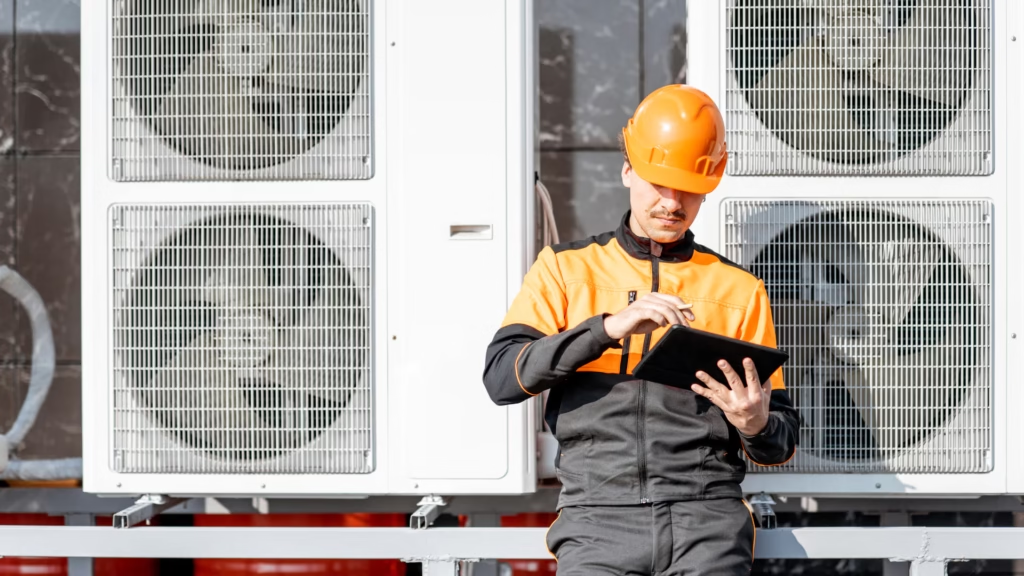
ASHRAE also makes clear that the purpose of commercial HVAC inspection and maintenance is to preserve acceptable thermal comfort, energy efficiency, and indoor air quality. Complementing that, ASHRAE Standard 62.1 identifies ventilation and acceptable IAQ as a building-system responsibility that includes filtration, controls, air cleaning systems, and operations and maintenance. Put simply, a commercial service program has to verify that the system is moving the right air, draining moisture correctly, and delivering stable cooling under control—not merely that it turns on.
For building managers, that means the service contract should produce measurable outputs: a complete asset list, service frequencies, condition findings, operating logs, escalation thresholds, and a record of corrective actions. For technicians, it means every visit should have a repeatable order of operations and a clear decision point between routine maintenance and advanced diagnostics.
Step-by-step commercial air conditioning servicing procedure
Start with safety, access, and work scope
Every commercial service visit should begin with a pre-task review: identify which assets are being serviced, confirm access, verify rooftop and electrical safety requirements, review recent alarms or complaints, and determine whether the visit is preventive, complaint-driven, or follow-up corrective work. ASHRAE Standard 180 requires the maintenance plan to identify responsible parties, authorizing parties, task documentation procedures, and evaluation or feedback procedures.
Before opening panels, isolate hazardous energy. OSHA’s lockout/tagout rule applies to servicing and maintenance where unexpected energization or stored energy could injure workers. Manufacturer guidance for commercial rooftop units is equally direct: turn the unit off, lock the main disconnect open, and verify absence of power with a voltmeter before servicing. Rooftop work also triggers fall-protection planning, and OSHA requires employers to provide and install required fall-protection systems before work begins.
Arc-flash risk deserves its own mention. OSHA’s guidance on electric-arc flash hazards emphasizes that de-energized equipment is not yet an electrically safe working condition unless it has also been properly locked out or tagged out and tested to verify absence of voltage. That matters in packaged units with large electrical panels, disconnects, and motor control components.
Inspect filters, airflow, and ventilation components
Start your hands-on work with airflow fundamentals. Inspect return-air filters and replace or clean them as needed. Commercial manufacturer guidance explicitly warns not to operate the unit without filters, because filter absence rapidly contaminates coils and compromises both airflow and IAQ. In a building-manager context, this is one of the fastest ways to separate a healthy PM program from a superficial one.
Next, inspect the outdoor-air and return-air damper assembly, hinges, pins, and linkages. Trane’s guidance calls for checking that moving parts are securely mounted, blades are kept clean, and linkages move freely. This is particularly important for units with economizers or ventilation sequences, because poor damper operation can create simultaneous comfort complaints, excess humidity, and wasted energy. ASHRAE Standard 62.1 also reinforces that ventilation performance depends on controls and operations, not just on original design.
If the unit has a belt-drive fan section, inspect belts for fraying and wear, replace in matched sets when required, and verify tension correctly rather than by guesswork. Trane’s service procedure specifies using a belt-tension gauge, calculating the required deflection from the center-to-center shaft distance divided by 64, comparing measured force against the belt table, and rechecking tension during the first two to three days of operation as new belts run in. This is precisely the kind of step technicians skip when maintenance is rushed, and it is one of the reasons “preventive” visits sometimes fail to prevent anything.
Clean and verify coils, drainage, and moisture control
Drainage is a reliability issue and an IAQ issue. During monthly maintenance, manufacturer guidance calls for checking drain pans and condensate piping for blockages and for verifying free movement of the overflow switch float if one is installed. In addition, commercial rooftop drain connections on the negative-pressure side of the fan require a condensate trap, and one manufacturer specifies pitching horizontal drain lines at least 0.5 inch per 10 feet to avoid sagging, air lock, and backup.
That drainage discipline matters because moisture problems are not merely cosmetic. EPA’s moisture-control guidance treats HVAC systems as an important part of building moisture management and specifically positions operating and maintenance personnel as a target audience for preventing moisture-related building problems. In practical terms, that means clogged drains, standing water, and chronic overflow events should be treated as building-environment risks, not just nuisance service calls.
Coils come next. Commercial manufacturer guidance directs technicians to inspect evaporator and condenser coils for dirt and bent fins and to clean dirty coils according to the manufacturer’s procedure. The same guidance notes that regular coil maintenance, including annual cleaning, improves operation by reducing compressor head pressure and amperage draw, evaporator carryover, fan brake horsepower, static pressure losses, and airflow reduction. If you are speaking to a building manager, that translates into a clear value statement: clean coils help control both energy costs and nuisance failures.
Microchannel coils require special caution. Trane’s published maintenance instructions specifically state that detergents should not be used on microchannel condenser coils and that cleaning should be performed with pressurized water or air only, with pressure not greater than 600 psi, applied perpendicular to the coil face with roughly 1 to 3 inches of nozzle clearance. That is an excellent example of why advanced service should follow manufacturer-specific instructions rather than generic field habits.
Test electrical, controls, and refrigeration performance
After mechanical cleaning and airflow work, move to electrical and operational checks. Manufacturer guidance calls for verifying tight wire terminal connections, checking for damaged wire insulation, reviewing the control panel for loose electrical components, and generally inspecting the unit for unusual conditions such as loose panels or leaking piping. If there is corrosion on the exterior, remove it and repaint as appropriate. These are not glamorous tasks, but they are exactly the findings that reduce callbacks when documented and corrected early.
With the unit running under stable conditions, record actual operating data. Trane’s commercial maintenance procedure calls for recording ambient temperature, compressor oil level where applicable, suction pressure, discharge pressure, superheat, and subcooling, and recommends placing this information into an operator maintenance log. This is one of the clearest dividing lines between routine cleaning and actual servicing: if no one records baseline operating data, then trend-based diagnosis becomes guesswork.
If pressure readings indicate a refrigerant shortage or other refrigerant-side problem, stop treating the issue as a simple tune-up. EPA Section 608 prohibits intentional venting of refrigerants and requires technician certification for servicing work that could release refrigerant. EPA also requires corrective action when certain appliances with a full charge of 50 pounds or more exceed applicable leak thresholds; for comfort cooling, the trigger rate is 10% over a 12-month period. Even where the legal leak-rate rule does not apply to a given piece of equipment, the field principle is the same: diagnose, recover, repair, verify, and document.
Modern refrigerant transition issues also matter. AHRI notes that the HVACR industry is implementing a transition to next-generation refrigerants under current policy frameworks and provides technician best-practice resources for A2L installation and servicing. In practice, that means technicians and building managers should confirm the actual refrigerant and safety labeling on each asset before using tools, leak procedures, storage practices, or replacement parts based on older assumptions.
Preventive maintenance checklist
A useful commercial checklist is short enough to execute but detailed enough to audit. At minimum, every preventive maintenance visit should verify these items: power isolation completed correctly; filters inspected or replaced; drain pans, piping, traps, and overflow devices checked; evaporator and condenser coils inspected; fans, bearings, and mounting hardware inspected; dampers and linkages checked; electrical terminals and insulation reviewed; operating pressures and temperatures logged where appropriate; and all panels reinstalled securely after service. ASHRAE Standard 180 supports this checklist mindset by requiring applicable tasks to be included in the maintenance plan and documented when performed.
For high-value buildings, add three management checkpoints: first, compare the technician’s readings against previous visits; second, require photographs for dirt, corrosion, damaged insulation, standing water, or damaged belts; and third, force a clear classification of findings into “watch,” “correct now,” and “capital plan.” That approach converts the service log into an asset-management tool rather than a folder of invoices. The logic is consistent with ASHRAE’s emphasis on archived task execution and evaluation/feedback procedures.
Documentation and client communication best practices
Good documentation begins before the first wrench turns. ASHRAE Standard 180 requires an inventory of HVAC items to be inspected and maintained and says that the list should include manufacturer data, location, capacity, and maintenance program identifiers. For building managers, that means every asset should have a unique ID and a known service history. For technicians, it means every reading and recommendation should tie back to a specific piece of equipment, not just “roof unit serviced.”
At the visit level, document what was inspected, what was cleaned, what was adjusted, which readings were taken, and what conditions require follow-up. Manufacturer maintenance guidance specifically recommends recording ambient temperature, suction pressure, discharge pressure, superheat, subcooling, and related operating data in a maintenance log. OSHA and EPA-related items should also be traceable in the file where applicable, especially when refrigerant work, energy isolation, or incident follow-up is involved.
Communication with the client should be plain, brief, and ranked by urgency. BLS describes HVAC technicians as workers who discuss malfunctions with customers, recommend maintenance to improve performance, and keep records of work performed. The best field reports therefore translate technical findings into business language: “Unit still operating, but condenser coil loading is raising head pressure”; “Drain trap is installed, but line pitch and blockage risk need correction”; “Economizer linkage binds and may affect ventilation performance and utility cost.”
When routine maintenance becomes advanced service
Routine servicing becomes advanced service when the technician has evidence that cleaning and basic visual inspection cannot explain the complaint. Common examples include repeated high-pressure or low-pressure trips, persistent humidity complaints after filter replacement, abnormal compressor running characteristics, unexplained freeze-up, significant deviation from logged superheat or subcooling baselines, visible oil residue suggesting a potential refrigerant leak, or damper/control behavior that contradicts the sequence of operation. Manufacturer guidance to log core operating data exists precisely so these transitions can be identified objectively rather than by intuition alone.
For building managers, the practical rule is simple: do not ask a preventive-maintenance visit to absorb an unresolved diagnostic problem without changing the work order scope. If the contractor has reached refrigerant circuit diagnostics, control troubleshooting, or repeated fault isolation, the job is no longer routine PM. It should be authorized, documented, and priced as advanced service so that the time spent actually matches the risk and skill required. EPA, OSHA, and manufacturer guidance all support this distinction by tying certain tasks to certification, hazard control, or formal procedures.
FAQs
How often should a commercial air conditioner be serviced?
A monthly visual and filter/drain review is a strong baseline for most commercial systems, with deeper quarterly and annual tasks layered on top. ASHRAE Standard 180 requires defined maintenance frequencies, and commercial rooftop manufacturer guidance explicitly includes monthly checks and annual coil cleaning.
What is the difference between routine maintenance and advanced servicing?
Routine maintenance focuses on cleanliness, airflow, drainage, and visible condition. Advanced servicing adds measured operating data, fault isolation, controls work, and regulated refrigerant procedures. The difference is usually the shift from inspection tasks to diagnostic or corrective tasks.
Can a technician connect gauges without EPA certification?
In the U.S., EPA defines a technician as someone who attaches and detaches hoses and gauges to measure system pressure in covered equipment, and that technician must be certified under Section 608 if the work could release refrigerant.
Why are dirty coils such a big issue in commercial HVAC?
Manufacturer guidance states that regular coil maintenance helps reduce compressor head pressure, amperage draw, static pressure losses, evaporator carryover, and airflow reduction. Dirty coils also tend to amplify comfort complaints and operating cost.
Do all commercial units need belt checks?
No. Direct-drive systems do not have fan belts, but belt-driven systems do. Where belts exist, they should be inspected for wear, replaced in matched sets, and tensioned with proper measurement rather than by feel.
Why is condensate maintenance a priority?
Blocked drains and poor trap or line configuration can cause overflow, air lock, and standing water. EPA’s moisture guidance also treats HVAC upkeep as part of moisture control in buildings, which affects IAQ risk as well as equipment reliability.
What readings should be logged during advanced service?
At minimum, log ambient temperature and—where applicable—compressor oil level, suction pressure, discharge pressure, superheat, and subcooling. Trend data makes future diagnosis faster and more defensible.
When do leak-repair rules matter most?
EPA’s federal leak-repair triggers apply when an appliance with a full charge of 50 pounds or more exceeds the applicable 12-month leak threshold. For comfort cooling, that trigger is 10%. Local or owner requirements may be stricter.
Are newer low-GWP refrigerants changing service practices?
Yes. AHRI notes the industry transition to next-generation refrigerants and provides best-practice resources for A2L installation and servicing. Technicians should verify the actual refrigerant and unit labeling before selecting tools or procedures.
What should a building manager require in every service report?
Require asset ID, date, technician name, tasks performed, photos where relevant, measured operating data, parts used, safety or compliance notes, and a ranked recommendation list by urgency. That approach aligns with ASHRAE’s documentation model and with the technician’s real-world duty to explain findings and keep records.